How and When to Get One
By Gloria Madera, public relations manager for CHRISTUS Health
November is Lung Cancer Awareness Month, bringing attention and education about the second most common cancer in women.
The American Cancer Society estimates that in 2025, there will be more than 226,000 people diagnosed with lung cancer, with more than half being women.
“Lung cancer develops as an uncontrolled growth of abnormal cells in the lungs,” said Dr. Gia Dice, internal medicine physician with CHRISTUS Health. “It is the number one cause of cancer deaths despite being the second most common cancer behind breast cancer in women.”
Dice is multi-board certified in internal medicine, medical oncology and hematology.
She said there are two types of lung cancer, small-cell and non-small-cell. Most lung cancers detected are non-small cell, which is the kind that originates in the airway and lungs. She said the treatment approach is different for the two types of lung cancer, but that the small-cell type typically has a poorer prognosis.
“Those who smoke have the greatest risk of lung cancer, and their risk increases the longer they smoke and the more cigarettes they smoke,” she said. “But those who are exposed to long-term second-hand smoke and other carcinogens are also at risk.”
Currently, the U.S. Preventive Services Task Force recommends annual lung cancer screenings for adults ages 50 to 80 who currently smoke or have quit smoking within the last 15 years and have at least a 20-pack-year smoking history.
Dice said that while smoking is the number one reason patients develop lung cancer, up to 20% of women diagnosed with lung cancer do not smoke.
Often, lung cancer is detected late because symptoms do not always present early on. By the time a patient experiences symptoms, they may likely already be in the advanced stages.
“Annual lung screenings increase a patient’s chance of detecting the cancer early,” Dice said.
Some symptoms of lung cancer are:
1. coughing up blood
2. shortness of breath
3. chest pain
4. hoarseness
5. loss of appetite
6. unexplained weight loss
7. feeling tired or weak
8. persistent infections such as bronchitis and pneumonia
Lung cancer screenings can detect cancer in its earlier stages before a patient exhibits symptoms, leading to an increase in chances for a cure.
Dice said there is a trend towards improved survival due to new technology that allows experts to find and treat lung cancer sooner and in a less invasive manner. But it all depends on when the cancer is detected.
CHRISTUS Santa Rosa Hospital – Westover Hills has invested in new technology, enabling patients to detect and treat lung cancer more effectively, ultimately achieving the best possible outcomes.
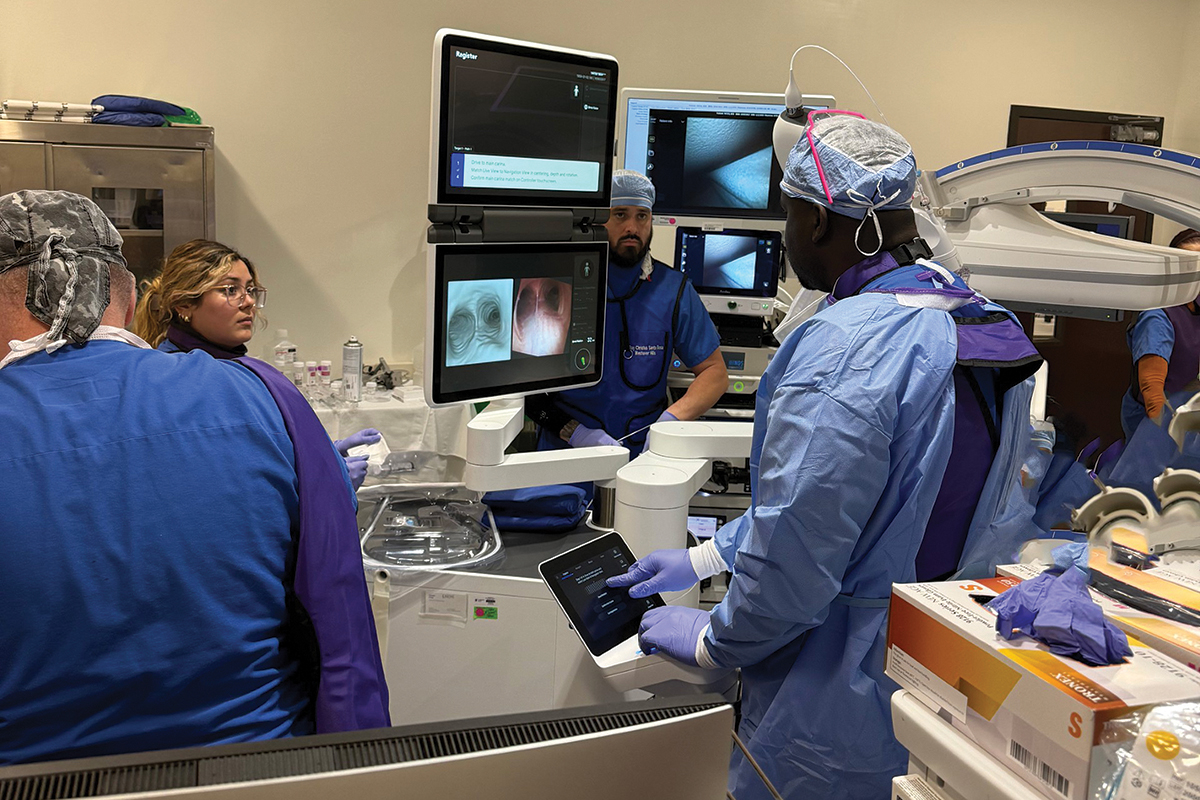
“This breakthrough technology is the first of its kind for the west side of San Antonio,” said Renee Spence, lung nodule navigator for CHRISTUS Santa Rosa Hospital – Westover Hills. “The Ion Robotic Navigational Bronchoscopy is a tool we have that allows physicians to get more precise biopsies of masses that were previously not accessible by traditional procedures, while also minimizing the risks.”
She said that during the procedure, a small breathing tube is placed as the surgeon guides it through the natural airway passages. This reduces the chance of complications.
“Using this technology allows our team to detect lung cancer early so intervention can start now,” Spence said. “Our patients now have a safer alternative with this minimally invasive approach.”
In addition to the latest technology, Spence said the hospital has invested in creating a comprehensive lung nodule program, offering the latest medical technology and providing compassionate support throughout every step of the process – from screening and diagnosis to treatment and recovery.
“It is important to have this level of care here on San Antonio’s west side because it brings specialized care close to home,” Spence said. “If someone is diagnosed with cancer, we know that historically they do better with having support close to home, and that is extremely important to us.”
It is essential to establish care with a primary care provider and for patients to be honest about their family history, as well as to disclose information about their own personal health care history.
“I work with each patient and go over their history to make the best decisions in their care,” Dice said. “But lung cancer screenings do save lives because they detect cancer early.”
To learn more about lung cancer or to find a primary care physician, visit our website at CHRISTUSHealth.org.