
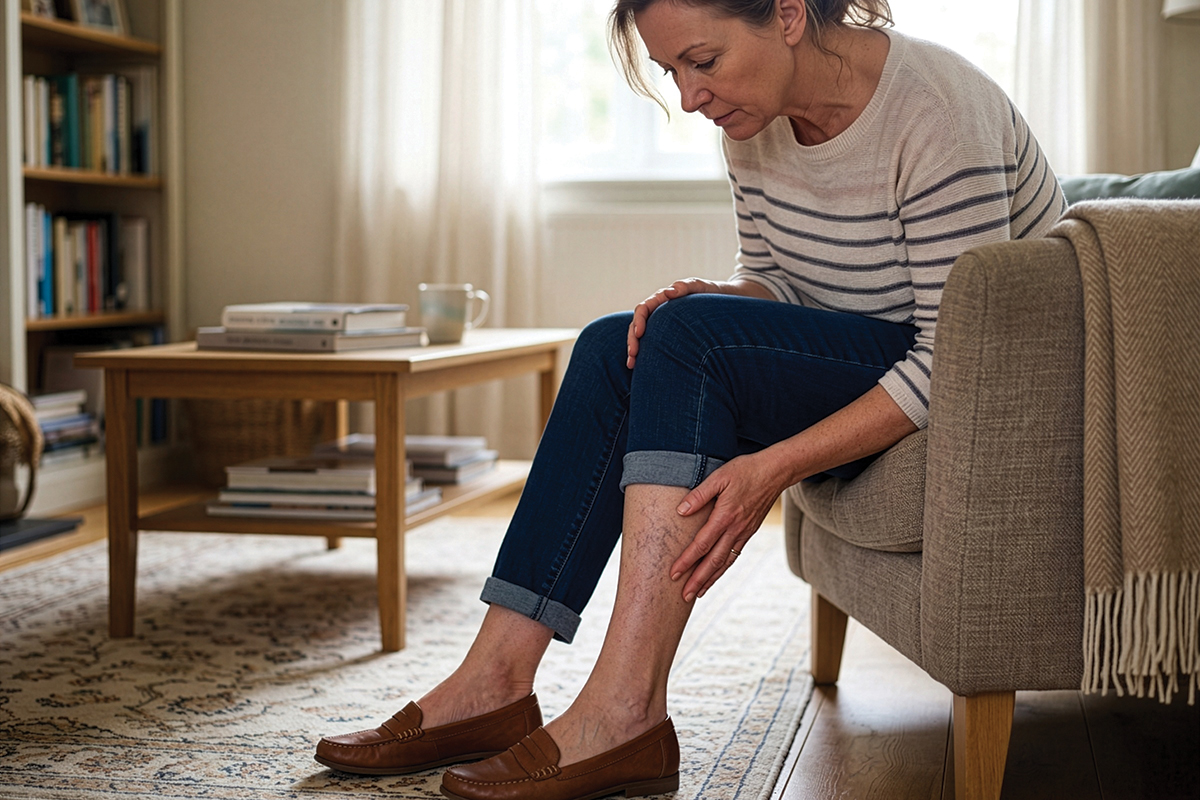
Spider veins on your legs and other indications that a medical evaluation is warranted.
By John Hogg, MD, DABR, DABVLM, RPVI, RPhS, RVT, RVS Founder, Medical Vein Clinic
Most women we see who come in asking about their spider veins start with a version of the same sentence. “I just want them to look better before summer.” And, sometimes the answer really is a cosmetic fix. But more often, the spider veins on the surface are the visible end of something happening deeper in the legs.
What we may think is a beauty concern can turn out to be progressive, but treatable vein disease.
“Spider veins and varicose veins are not the same thing?”
Spider veins are the fine red or blue lines that web across the surface of the skin, usually on the thighs, calves, or ankles. Varicose veins are the larger, raised, ropey ones that bulge above the skin. They look different, and people often treat them as two separate issues, but they usually share the same root cause: a one-direction valve deeper in the leg that has stopped closing properly, letting blood pool and fall down instead of moving back toward the heart. Doctors call it venous insufficiency, and it’s the reason spider veins so often come back with a vengeance after they’re treated at the surface. If nobody addresses the source of the problem, the pressure feeding them, they will refill.
This is why it’s important to have a thorough mapping venous ultrasound, read by someone trained to interpret it, to determine whether those surface veins are cosmetic or a symptom of vein disease.
“It doesn’t hurt, so it’s fine?”
Absence of pain gets read as absence of disease, and that assumption costs women valuable time deterring vein disease. “Pain is the least common symptom I ever see with serious underlying vein disease”. Heaviness in your legs by the end of the day, aching legs, swelling around the ankle, night cramps, restless legs, itching, and changes in the color of the skin near the ankle are all more common signs of venous trouble. People frequently chalk them up to age or to standing all day at work, and wait. “My mother had these; it’s just genetic” is the close cousin of this one. Family history is a real risk factor. It is not a reason to do nothing about it.
“I’ll just take a water pill for the swelling.”
This is the misconception that worries us most, because it can be dangerous. Diuretics, the “water pills” some women reach for when their legs swell, are made to pull fluid off the whole body for conditions like heart or kidney problems. The swelling from venous insufficiency is a local pressure problem in the leg, and a diuretic doesn’t fix it. What it can do is dehydrate someone, drop their blood pressure, and throw their electrolytes out of balance, which, for an older woman or someone on other medications, can quickly turn serious.
One of our patients, Judith (who generously allows us to talk about her medical journey), learned this the hard way. She’d been managing her leg swelling with water pills for months before she came in and was closer to a real medical emergency than she realized. Her swelling was from venous disease. It needed compression and a proper diagnosis, not a pill borrowed for the wrong job.
“The med spa said the laser would take care of it”
Unfortunately, the wellness market has muddied the waters for patients seeking relief from spider veins. “Laser for veins” can mean two completely different things. A surface laser can fade tiny spider veins, a cosmetic result. Endovenous laser ablation and radiofrequency ablation (RFA) treat the failing vein underneath, and so does Varithena, a foam that closes the diseased vein from the inside. VenaSeal, a medical acrylate glue, also closes the vein. Those are medical procedures that should follow an ultrasound and be done by a certified vein specialist. When a spa advertises “laser for veins,” a woman often can’t tell which one she’s getting, and frequently it’s the surface treatment sold as if it solves the deeper problem that caused the spider veins in the first place.
“Can I just get a lymphatic massage instead?”
Lymphatic drainage massage is everywhere on social media right now, promoted for everything from de-puffing your face to treating swelling that needs real medical management. The honest version: a lymphatic massage can feel wonderful and temporarily reduce puffiness, and it has a legitimate, limited role in supervised care. But for the kind of chronic swelling that comes with venous or lymphatic disease, regular compression is the part that actually works. The research is consistent on this. The gentle hand movements temporarily help with comfort and quality of life at the margins; the compression does the heavy lifting.
The nine-minute Instagram routine that promises to treat lymphedema is the sharpest example of the problem. Lymphedema and lipedema are real medical conditions, often misdiagnosed and often confused with each other, and they need a diagnosis and a full treatment plan from a trained clinician. A phone video is not that, and choosing a convenient option over a thorough clinical evaluation may mean a manageable condition gets worse.
The same first step, either way
Whether a woman walks in wanting her legs to look better or because they ache by dinnertime, the path forward begins in the same place. A thorough medical examination and a dedicated venous mapping ultrasound show what’s happening beneath the surface, and a vein specialist can tell her whether she’s looking at a cosmetic touch-up or a medical condition that’s been quietly progressing. Most of the women who delay treatment do it because they assume it’s vain (no pun intended), to ask. It isn’t. If your legs are trying to tell you something, it’s our job to listen and provide care.
John Hogg, MD, DABR, DABVLM, RPVI, RPhS, RVT, RVS Founder & CEO, Medical Vein Clinic®, Board-Certified in Diagnostic Radiology, Diplomat of the American Board of Venous & Lymphatic Medicine, Registered Physician in Vascular Interpretation, Registered Phlebology Sonographer, Registered Vascular Technologist, Registered Vascular Specialist