A Chef’s Heart, A Community’s Table
By Michelle Vasquez | Photography by David Teran
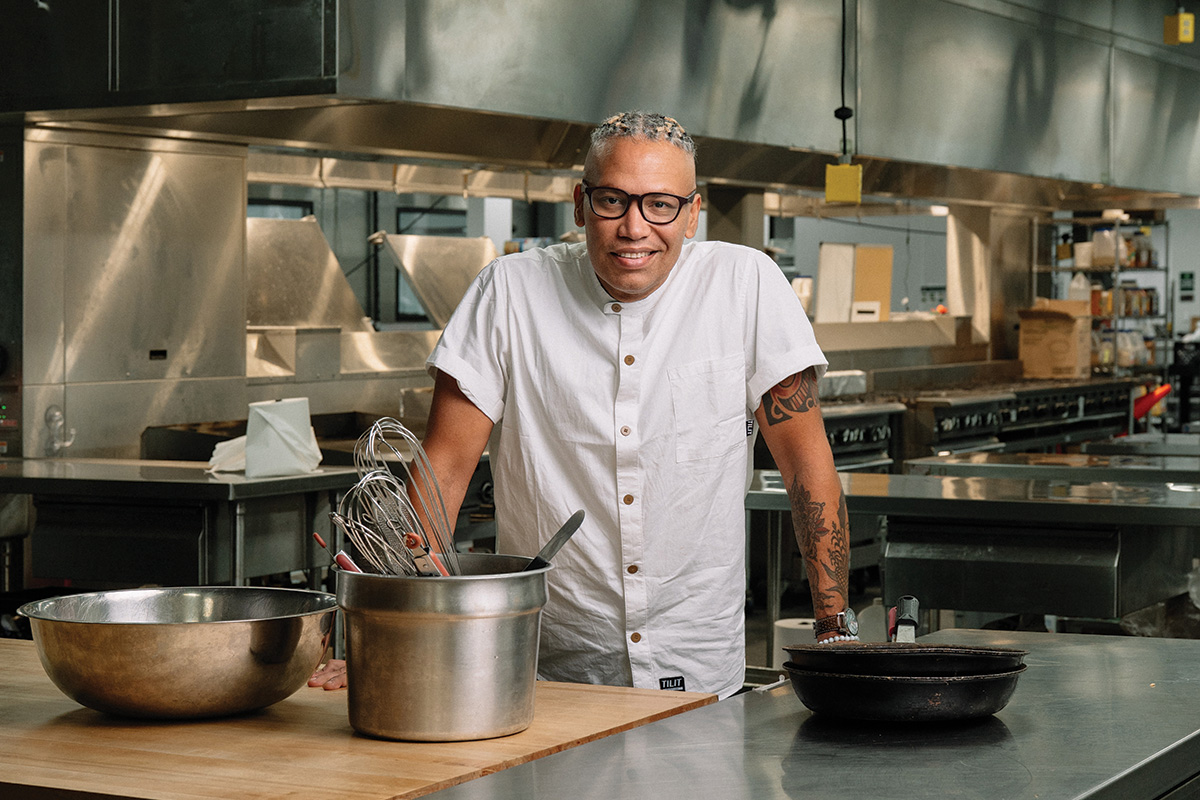
Chef Geronimo Lopez’s enthusiasm has a way of drawing people in. When he talks about food, childhood curiosity and professional pride quickly become a conversation about caring for others. His love of cooking is inseparable from his interest in the people gathered around the table. At the San Antonio Food Bank, that connection gives his work a clear purpose: “The main goal for us in the food bank is to nourish our neighbors.”
His fascination with food began in Caracas, Venezuela, where European and Middle Eastern immigration contributed to a cosmopolitan food culture. Later, while his parents pursued doctoral degrees in Chicago, a connection through his mother brought him into a restaurant kitchen. Watching the chef work inspired experiments of his own. “I was burning things since I was like 8, 9 years old in the kitchen trying to do cookies and any recipe I could get my hands on.”
By 15, Lopez knew he wanted to cook professionally, although he was still discovering how to make that happen. Training under a French chef in Caracas led to culinary studies in France, supported by a scholarship. His career would eventually bring him to San Antonio’s Culinary Institute of America, his own restaurant, Botika, and Hotel Emma. Along the way, travel and hotel kitchens broadened his understanding of flavors and cultures, giving him more to share with others.
The standards instilled early in his career remain central to his approach. Lopez names “discipline, consistency, responsibility” among his guiding principles and emphasizes the teamwork required to serve people well every day. Excellence means maintaining those standards through fatigue, pressure, and personal challenges. His move into nonprofit work brings that same professional commitment to diners whose circumstances may be very different from those of his restaurant guests.
Food insecurity gives that commitment urgency. “The reality is that 20% of the people that live in Texas we know, are food insecure,” Lopez says. For him, the scale of that uncertainty makes the Food Bank essential and strengthens his determination to provide nourishing meals made with love. After decades of cooking for people who could pay for a dining experience, he wants to extend its pleasures and thoughtful preparation to those facing hardship.
His relationship with the Food Bank began through fundraisers and deepened through its culinary committee. During the pandemic, the “Good Food for Good” project put Botika’s kitchen to work preparing meals for people across San Antonio and allowed him to rehire employees. “And that was my salvation, to be honest, in the pandemic,” he says. Keeping his team cooking sustained him personally while opening his eyes to the needs around him.
That involvement eventually became a position encompassing a production kitchen, catering kitchen, deer processing plant, and 60-acre farm. Lopez describes daily kitchen production of 5,000 meals, with summer production reaching 15,000 meals a day for children’s programs. The work requires managing many moving parts while finding ways to improve what reaches each plate. His motivation remains personal: “I feel that I want to bring a piece of that experience to everybody.”
Sometimes that begins with something as simple as meatballs, made from scratch with attention and love. It also includes teaching children and adults to choose seasonal ingredients, incorporate vegetables, and stretch their grocery budgets. Familiar dishes such as menudo, pozole, and barbacoa connect practical lessons with regional flavors and cultural pride. Teaching someone to prepare a nourishing meal offers skills and enjoyment they can bring into their own home.
Lopez also recognizes how much a meal can communicate. “We’re serving food with dignity for the people,” he says. Thoughtful preparation and familiar flavors acknowledge the person receiving the plate with a simple message: “I see you.” His belief that “food is medicine and food is love” connects nutrition with that recognition of another person’s humanity.
His enthusiasm invites others to participate in the work. Through growing, cooking, distributing, and teaching, the Food Bank offers many ways to help nourish its neighbors. Lopez’s invitation to the community is direct: “We need them to support us, to spread the message and to volunteer.”